

State Ohm’s law? How can it be verified experimentally? Does it hold good under all conditions? Comment.
Ohm’s Law: At constant temperature, potential difference across a conductor is directly proportional to electric current passing through it. If V is the potential difference and I is electric current, then as per Ohm’s law;
VαI
or V/ I = R
Where R is the constant of proportionality and it is called resistance.
Verifying Ohm’s Law:
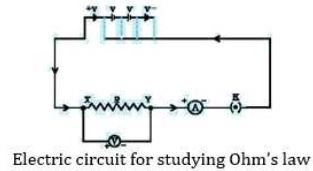
• Take a nichrome wire, some electric cells, key, voltmeter and ammeter.
• Connect the component to make a circuit; as shown in given figure.
• Start with 1 cell in the circuit. Switch on the key and take the reading of ammeter.
• Increase the number of cells to 2. Switch on the key and take the reading of
ammeter.
• Increase the number of cells in similar increments and take the reading of
ammeter in each case.
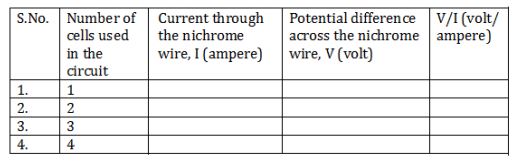
Tabulate your data and plot a V-I graph.
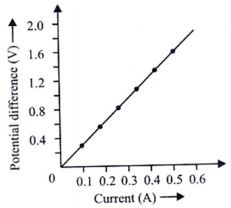
The graph shows that potential difference varies directly as electric current. Ohm’s law holds good under normal conditions. But, it may not hold good under exceptional conditions.
